Cannabis Seed Production and Finnish Law
Why the purpose of cultivation matters under the Finnish Criminal Code
01
The short answer
In Finland, cannabis seeds are not classified as a narcotic. They can be bought, sold and possessed. Growing cannabis for narcotic purposes, on the other hand, is a narcotics offence.
The key detail is in the wording of the law. The Finnish Criminal Code does not describe the offence as cultivation as such — it describes cultivating the cannabis plant for use as a narcotic or as a raw material for one. Purpose is part of the statutory definition, which is why cannabis seed production in Finland raises a genuine legal question rather than having an automatic answer.
This article separates three things: what the statute says, what a court has actually decided, and our own analysis. Only the first two are law.
This article is general information, not legal advice. It does not promise that any cultivation is lawful. Laws, prosecution practice and court interpretations can change, and every case is decided on its own evidence. Consult a Finnish lawyer before germinating or cultivating cannabis.
02
What the Criminal Code says
Statutory wording: Chapter 50, section 1 of the Finnish Criminal Code (rikoslaki 39/1889) defines the narcotics offence. Among other acts, it covers a person who unlawfully cultivates opium poppy, coca bush or the cannabis plant for use as a narcotic or as a raw material for a narcotic. The current consolidated text is published in the official Finlex legislation database.
Because the purpose is written into the definition, it is an element the prosecution must prove. Finnish criminal procedure places the burden of proof on the prosecutor, and a conviction requires that no reasonable doubt remains about the defendant's guilt (Code of Judicial Procedure, chapter 17, section 3).
That does not mean the accused can stay passive in practice. The court weighs all of the evidence freely, and purpose is usually inferred from objective circumstances. If those circumstances point towards narcotic use, an unsupported claim of another purpose is unlikely to create reasonable doubt. A claimed seed-production purpose carries real weight only when it is backed by evidence.
03
Why seeds themselves are legal
Treaty text: the UN Single Convention on Narcotic Drugs, 1961, defines "cannabis" in article 1(1)(b) as the flowering or fruiting tops of the cannabis plant, excluding the seeds and leaves when not accompanied by the tops. Article 28(2) states that the Convention does not apply to cultivation of the cannabis plant exclusively for industrial purposes (fibre and seed) or horticultural purposes.
Finnish law: the Narcotics Act (huumausainelaki 373/2008) defines narcotics largely by reference to the substances controlled under the international conventions. Ungerminated seeds therefore are not treated as a narcotic, which is why they can be sold openly as collectables and genetics.
The treaty does not, by itself, decide Finnish criminal cases. Finnish courts apply the Criminal Code and the Narcotics Act; the Convention explains where those definitions come from. Legal seeds also do not, by themselves, make germination or cultivation lawful.
04
Seed production: cultivation without narcotic purpose
Our analysis: if cannabis is cultivated genuinely and solely to produce seeds, the element of narcotic purpose described in chapter 50, section 1 may be missing. On the wording of the statute, cultivation that is not for use as a narcotic or as narcotic raw material does not meet the definition of the cultivation offence.
Whether that is the outcome in a given case is not settled in advance. It depends on the applicable law at the time, the actual purpose of the cultivation, the evidence and all the circumstances — and a court assesses those afterwards. No Supreme Court precedent that we have been able to verify establishes a general rule for cultivation for seed production.
05
What the courts have said
Eastern Finland Court of Appeal, 14 October 2020, decision no. 20/137934 (Finlex record). The case concerned a hemp grower from Iisalmi who had cultivated hemp in 2017. We have confirmed that the official Finlex record exists, but the full judgment text was not available to us there; the summary below is based on contemporaneous reporting by Yle and STT / Ilta-Sanomat, and should be read with that limitation.
As reported: the District Court of North Savo dismissed the narcotics charge because it could not be established that the hemp was cultivated for narcotic purposes, but convicted the grower of a medicines offence. The Court of Appeal accepted the District Court's reasoning on the narcotics charge, held that he had not committed a narcotics offence by holding hemp flowers in order to obtain seeds, and also dismissed the medicines charge. According to the reports, the court found that the purpose was only to recover the seeds and breed a new seed variety, and that hemp seed is not a listed medicine.
What this shows: charges were dismissed because the elements of the offences were not proven — not because a prosecutor declined to charge, and not because an offence was found but punishment was waived. What it does not show: it is a Court of Appeal decision on its own facts, it concerned hemp with a reported cannabidiol content, and it is not a binding precedent. It supports the point that purpose is examined as a real element of the offence; it does not establish that seed production is lawful in every case.
06
Where the practical risks are
Purpose is assessed from the overall circumstances, not only from what the grower says. Authorities and courts may look at the variety, the plants, the equipment, the quantities, the setup, records, and what happens to the plant material. Openness — in the 2020 case the grower had reportedly told the police about his plans — and documentation can be relevant evidence.
Seeds develop inside the female flowers, and those flowers contain cannabinoids. Flowering or fruiting tops fall within the definition of cannabis, so retaining, drying, processing, storing or handing over flower material can raise separate questions under the possession and transfer provisions of chapter 50, independent of the cultivation question.
We are not aware of a statutory rule that prescribes one specific method or deadline for disposing of flower material in seed work, and the 2020 decision shows that holding flowers in order to obtain seeds was not, on those facts, treated as an offence. As practical risk management, though, the less flower material is kept beyond what seed recovery requires — and the clearer the records of how it is handled — the harder it is to infer a narcotic purpose.
07
Elsewhere in Europe
Cannabis rules are national, and they differ widely across the EU. For an overview of seed buying, Germany's KCanG and EU shipping, read our EU guide to buying cannabis seeds.
Continue the story
Explore Strain Station genetics
Related articles
The Story of Strain Station
How a project built around California genetics, Northern conditions and long-term development found its direction.
Read more
Photoperiod vs. Autoflower
How photoperiod and autoflowering seeds differ in the tent — light cycles, training, recovery time and control — and why Strain Station started with autoflowers before moving to feminized photoperiods.
Read more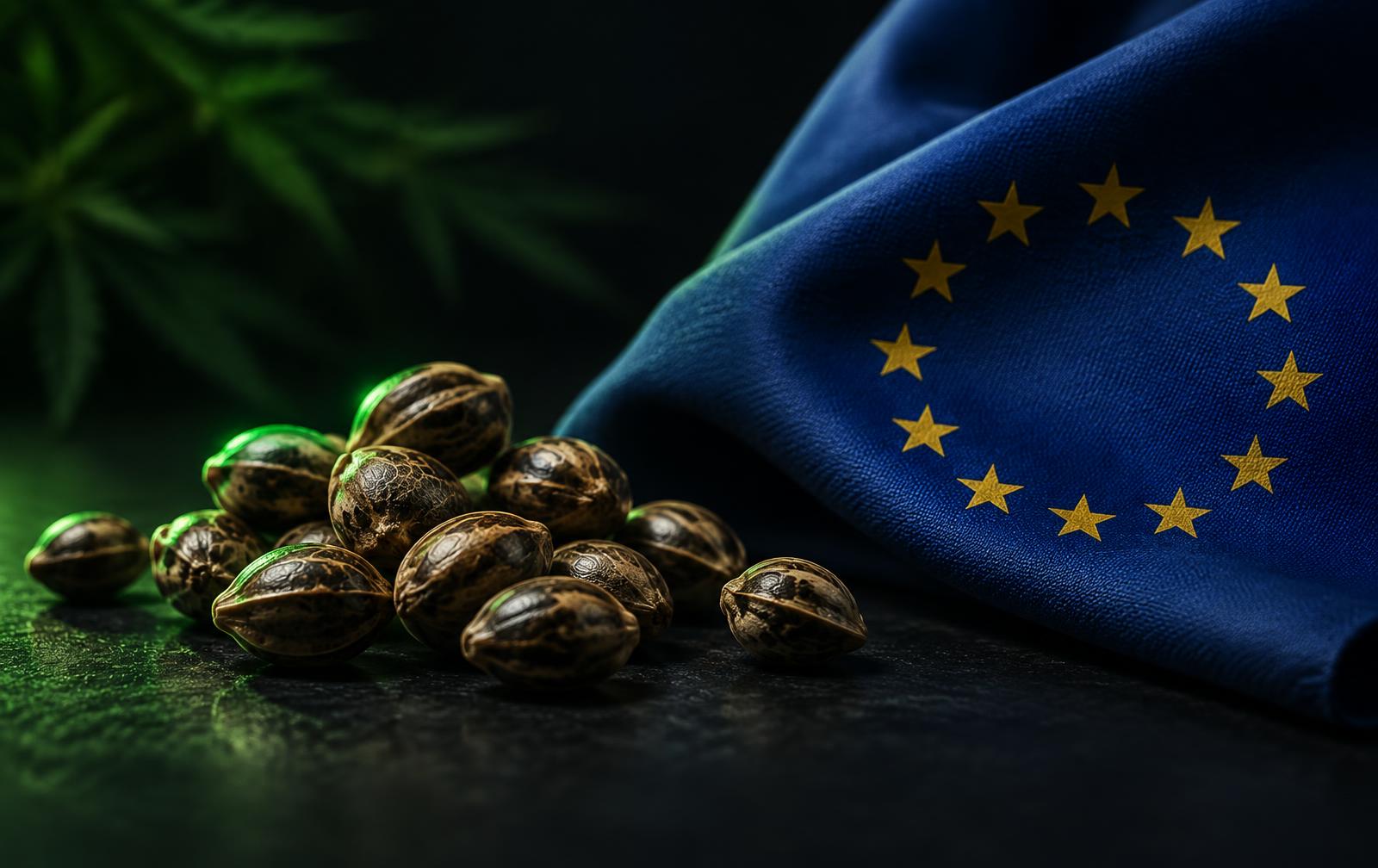
Buying Cannabis Seeds in the EU: The Complete 2026 Guide
A practical 2026 guide to buying cannabis seeds in Europe: national legal differences, Germany's KCanG framework, EU versus non-EU shipping, breeder genetics, storage, payment and how to choose.
Read more